
CAT Exam Pattern 2026: Sections, Marking Scheme, Syllabus & Duration
The Common Admission Test (CAT) is the most prestigious management entrance exam in India, serving as the gateway to the coveted IIMs and top B-schools like FMS, MDI, and SPJIMR. To crack this highly competitive exam, the very first step is understanding the CAT Exam Pattern.
The IIMs have largely standardized the pattern over the last few years. The exam is designed to test not just your knowledge, but your speed, accuracy, and decision-making under pressure. Let’s dive deep into the latest CAT exam pattern, sectional breakdown, marking scheme, and essential rules you need to know for 2026.
Quick Answer: What is the CAT Exam Pattern?
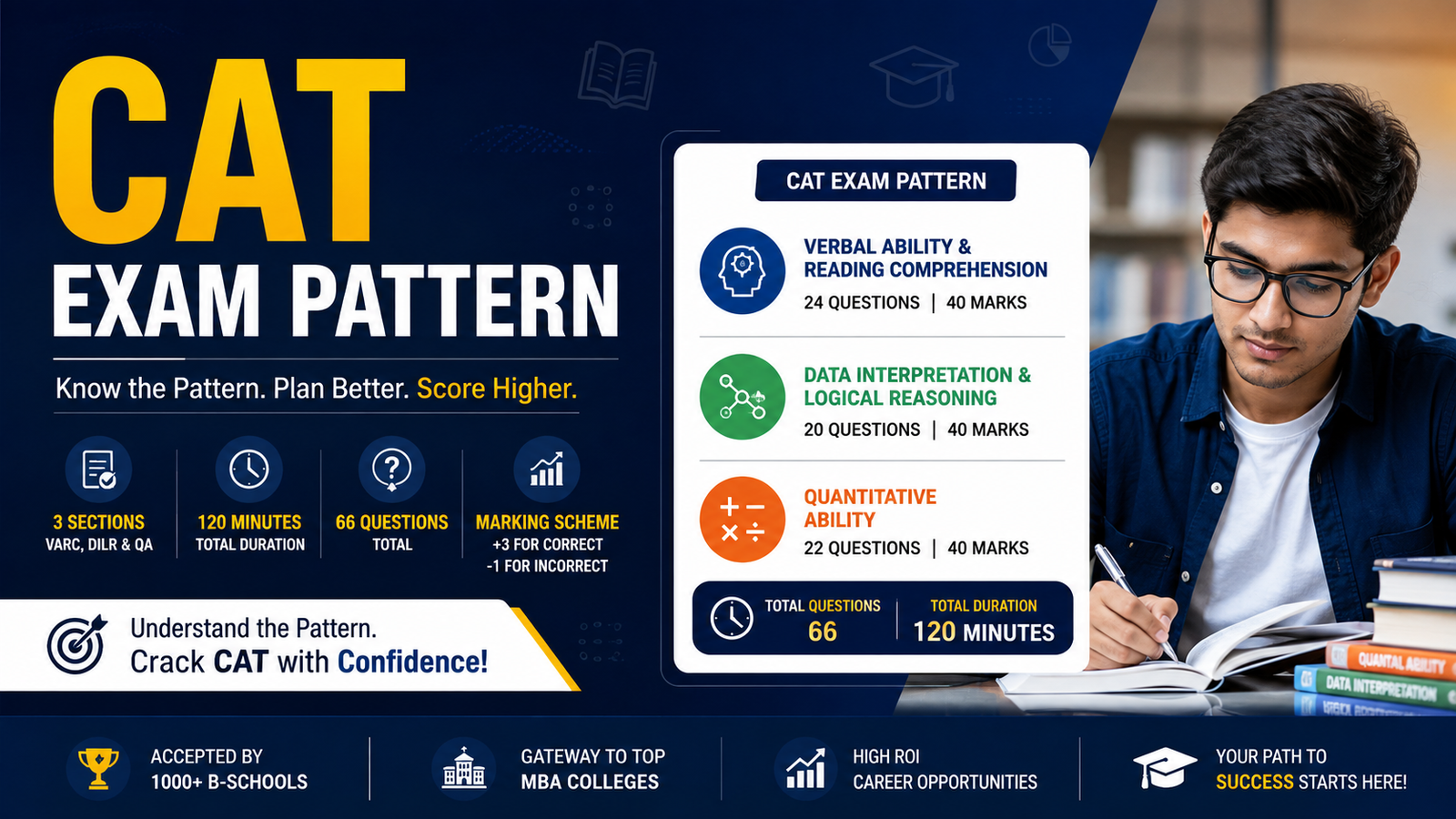
The CAT Exam Pattern consists of 3 sections: VARC (Verbal Ability & Reading Comprehension), DILR (Data Interpretation & Logical Reasoning), and QA (Quantitative Aptitude). The exam is computer-based, lasts for 120 minutes, and contains approximately 66 questions. Candidates are awarded +3 marks for correct answers, with a -1 negative marking for incorrect MCQs.
Detailed CAT Exam Pattern 2026
Here is the snapshot of the expected CAT exam pattern based on the most recent trends:
| Feature | Details |
|---|---|
| Mode of Exam | Computer-Based Test (CBT) |
| Total Duration | 120 Minutes (2 Hours) |
| Total Questions | Approx. 66 Questions |
| Total Marks | 198 Marks |
| Number of Sections | 3 (VARC, DILR, QA) |
| Sectional Time Limit | 40 Minutes per section (Non-negotiable) |
| Marking Scheme | +3 for correct, -1 for incorrect MCQ |
| Negative Marking for TITA | No negative marking for Type-In-The-Answer (TITA) questions |
| Medium of Exam | English |
Sectional Breakdown of the CAT Exam
The CAT exam is divided into three distinct sections. You must complete each section within its 40-minute time limit before the screen automatically moves to the next section. You cannot toggle between sections.
1. Verbal Ability & Reading Comprehension (VARC)
- Total Questions: 24
- Time Limit: 40 Minutes
- Breakdown: This section is heavily dominated by Reading Comprehension (RC), which usually accounts for 16 questions across 4 passages. The remaining 8 questions are from Verbal Ability (Para-jumbles, Odd One Out, and Summary).
- Pro Tip: RC passages can be dense. Practice speed-reading and identifying the main idea quickly.
2. Data Interpretation & Logical Reasoning (DILR)
- Total Questions: 20
- Time Limit: 40 Minutes
- Breakdown: This section contains about 4 to 5 sets (with 4-6 questions per set). The questions are split between Data Interpretation (bar graphs, tables, charts) and Logical Reasoning (puzzles, seating arrangements, blood relations).
- Pro Tip: Set selection is the make-or-break factor here. Spend the first 2-3 minutes scanning all sets and picking the easiest ones to solve first.
3. Quantitative Aptitude (QA)
- Total Questions: 22
- Time Limit: 40 Minutes
- Breakdown: This section tests your mathematical skills. Key topics include Arithmetic (Percentages, Profit & Loss, Time & Work), Algebra, Geometry, Number System, and Modern Math.
- Pro Tip: Arithmetic and Algebra usually carry the highest weightage. Ensure your fundamentals in these areas are rock solid.
CAT Marking Scheme & Negative Marking
Understanding the marking scheme is crucial to devising your “attempt vs. skip” strategy:
- Positive Marking: For every correct answer (both MCQ and TITA), you are awarded +3 marks.
- Negative Marking (MCQs): For every incorrect Multiple Choice Question (MCQ), 1 mark (-1) is deducted.
- No Negative Marking (TITA): Type-In-The-Answer (TITA) questions do not carry any negative marking. However, they are often trickier to solve as you cannot use the elimination method.
- Unattempted Questions: No marks are awarded or deducted for questions left blank.
Strategy: Because of the negative marking, blind guessing is heavily penaliz. Only attempt an MCQ if you can confidently eliminate at least two options.
Key Rules & Exam Day Interface
- On-Screen Calculator: Since the CAT is a computer-based test, a basic on-screen calculator is provided. You cannot bring your own physical calculator.
- Rough Workspace: You will be provided with a physical rough pad and a pen at the test center for calculations and rough work.
- Sectional Navigation: You must answer the sections in a sequential order (VARC -> DILR -> QA). You cannot jump forward or backward across sections.
- Marking for Review: The exam interface allows you to “Mark for Review” a question if you are unsure and want to revisit it later within the same 40-minute block.
Frequently Asked Questions (FAQs)
Yes, the CAT exam has a strict sectional time limit of 40 minutes per section. You cannot switch between sections, and the screen will automatically lock once the 40 minutes for a section are over.
Yes, there is a negative marking of -1 for every incorrect Multiple Choice Question (MCQ). However, there is no negative marking for Type-In-The-Answer (TITA) questions or for unattempted questions.
The CAT exam generally consists of 66 questions, divided across three sections: VARC (24), DILR (20), and QA (22).
No, physical calculators are strictly prohibit inside the exam hall. However, an on-screen calculator is provided on your computer screen for basic calculations.
The difficulty level varies yearly. VARC is usually moderate to tough (due to dense RCs). DILR is generally consider the toughest and most time-consuming. QA ranges from moderate to tough, with Arithmetic usually being the most scoring area.